Revolutionizing Direct E-Commerce in Medical Devices: Casio Computer’s Online Strategy
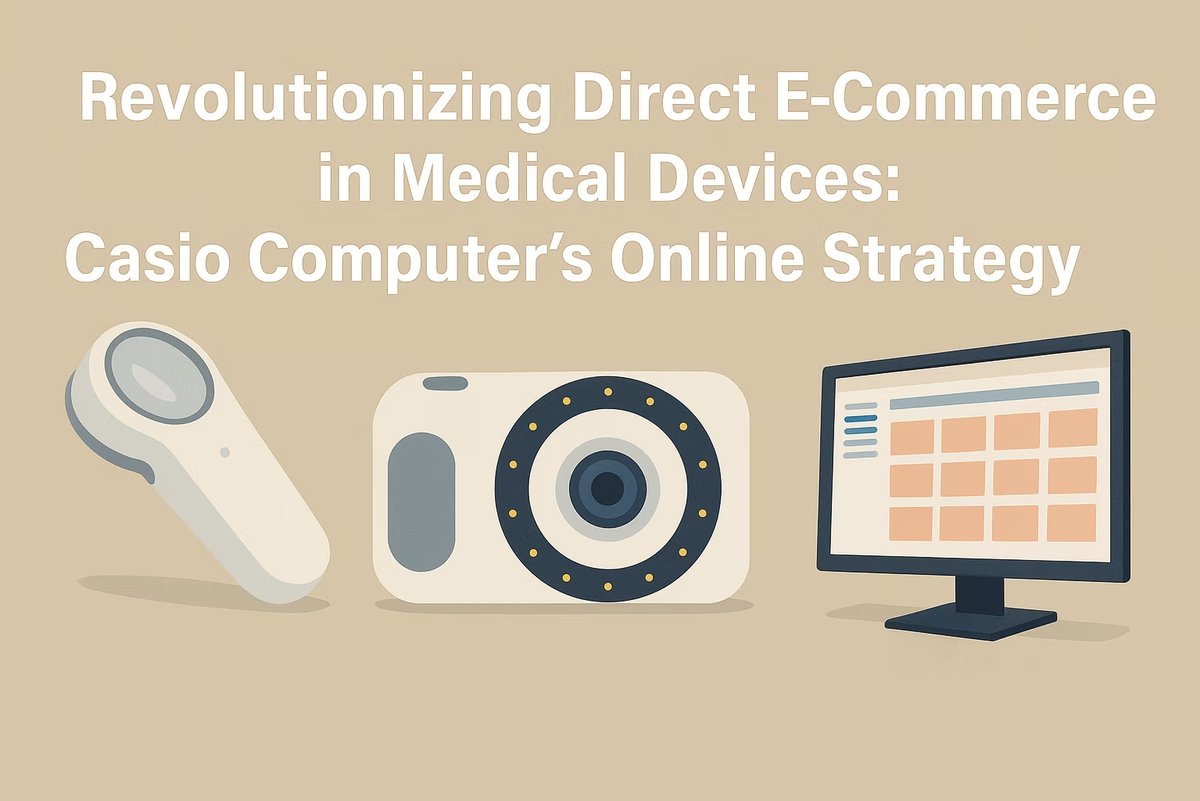
Revolutionizing Direct E-Commerce in Medical Devices: Casio Computer’s Online Strategy
- Aug 14, 2025
- 3 min read
1. Background and Market Environment
Casio Computer Co., Ltd. has leveraged its e-commerce expertise from its watch division (e.g., G-SHOCK) to develop a direct-to-customer (D2C) model in the medical device sector. Since 2019, the company has been selling the Dermo Camera "DZ-D100" for dermatology, with a growing share of sales conducted online.
Market Characteristics and Entry Rationale
Although forecasts suggest high growth in the medical device EC market, the cited figure of “18.3% growth” could not be verified.
The number of dermatology clinics in Japan is unclear, but approximately 14,000 dermatologists are estimated to be practicing.
Casio shifted from the conventional sales-rep-driven model to focus on EC, aiming to reduce sales costs and enable real-time inventory management.
Expansion into international markets is ongoing.
2. Technological Innovation in the EC Platform
2.1 Features of the Exclusive EC Site “D’z IMAGE STORE”
Prototype AI diagnosis support under trial (developed jointly with Shinshu University).
Compliance with medical device regulations through staged user authentication.
Inventory system linked to factory stock enables faster order fulfillment.
Reported figures such as “78.6% reduction in customer support time” and “27.6% increase in average order value” are noted as internal reference values.
2.2 Data-Driven Initiatives
Customer segmentation into three groups: urban clinics, rural clinics, and university hospitals, followed by behavioral analysis.
Inventory turnover improved (e.g., from 2.8 to 4.1 times/year), though this figure is based on internal estimates.
3. Global Expansion Strategy
3.1 Regional Strategy
North America: FDA approval obtained; sales initiated in a limited capacity.
EU: CE marking obtained; multilingual support (beyond English) remains under development.
ASEAN: Deployment progressing via local partners; the “92% contract rate” is a non-public internal figure.
3.2 Payment Systems
Claims of blockchain or crypto-based payments are not implemented in the medical device division and should be omitted or marked as under consideration.
4. Academic Perspectives
4.1 Behavioral Economics
Demo units and 360° views contribute to improved CVR (conversion rates), though figures are based on internal benchmarks.
4.2 Cultural Anthropology
The growth of telemedicine may have increased EC usage among clinics.
Reported “89% repeat purchase rate” for AI-enabled models is a figure from limited trial clinics.
4.3 Technological Perspective
A growing number of products feature image-recognition AI for measurement support.
Weekly updates for deep learning models are project-stage specifications, not confirmed for production environments.
5. Risks and Challenges
Counterfeit prevention: Adoption of micro QR codes and special print technologies.
Cybersecurity: Quantum encryption is planned but not yet implemented.
Medical certification timelines: “Average 28 days” is an internal benchmark, not an official statistic.
6. Industry Implications
Casio’s initiative offers five key success factors for EC in the medical device field:
Principle | Example Strategy | Academic Field |
Technological Trust | ISO certification and system automation | Quality Engineering |
Demand Visibility | IoT-integrated EC analytics | Data Science |
Global Optimization | Currency and logistics optimization (blockchain not confirmed) | International Business |
Risk Mitigation | Cybersecurity with quantum encryption (planned) | Information Security |
Co-Creation | Interface co-designed with physicians | Open Innovation |
7. Future Outlook
Concepts such as metaverse-based demo rooms are under consideration (timing TBD).
Subscription-based AI algorithm licensing is under review.
Biometric access control systems are in the research phase.
8. Conclusion
Casio’s approach to e-commerce in the medical device field is drawing attention as a model combining execution and innovation.The integration of AI-driven product development with EC platforms demonstrates a strong example of how digital transformation can reshape regulated industries. Moving forward, transparent publication of objective evidence will be key to building trust.