Maximizing Customer Acquisition Through a Three-Step Distribution Strategy: Repeat Exposure in the SNS Era Determines Sales
JASEC Japan Academic Society for E-Commerce
Maximizing Customer Acquisition Through a Three-Step Distribution Strategy: Repeat Exposure in the SNS Era Determines Sales
Feb 5
5 min read
Introduction: From “Quality” to Strategic Frequency
In live commerce, many factors influence sales, but one of the most underestimated is the timing and structure of promotional announcements. Despite this, many companies still operate under the assumption that a single, well-crafted announcement is enough to reach their audience.
That assumption no longer holds in today’s social media environment. Timelines move quickly, posts have a short lifespan, and audiences rarely remember information after seeing it just once. Instead of relying on memory, marketers must design multiple touchpoints that gradually build recognition.
Promotion is no longer a test of writing quality alone—it is a strategic exercise in controlling exposure frequency.
This article outlines a practical and scalable three-stage promotion strategy that companies can adopt immediately, along with the behavioral logic that makes it effective.
The Changing Nature of Promotion in the Live Commerce Era
Why Traditional Announcements Are Losing Effectiveness
In the television era, promotional messaging was simple. Program schedules were published in guides, viewers checked them in advance, and planned their time accordingly. Information remained accessible in a stable location.
Social platforms operate differently. Promotions now face three structural challenges:
-
Accelerated Information FlowPosts are quickly buried in feeds. If users miss a post once, there is no guarantee they will encounter it again.
-
Competition for AttentionUsers allocate only seconds to each piece of content while processing vast amounts of information simultaneously. Expecting a single post to create lasting recall is unrealistic.
-
Platform FragmentationAudiences are dispersed across Instagram, TikTok, X, YouTube, LINE, email newsletters, and app notifications. Relying on one channel inevitably creates blind spots.
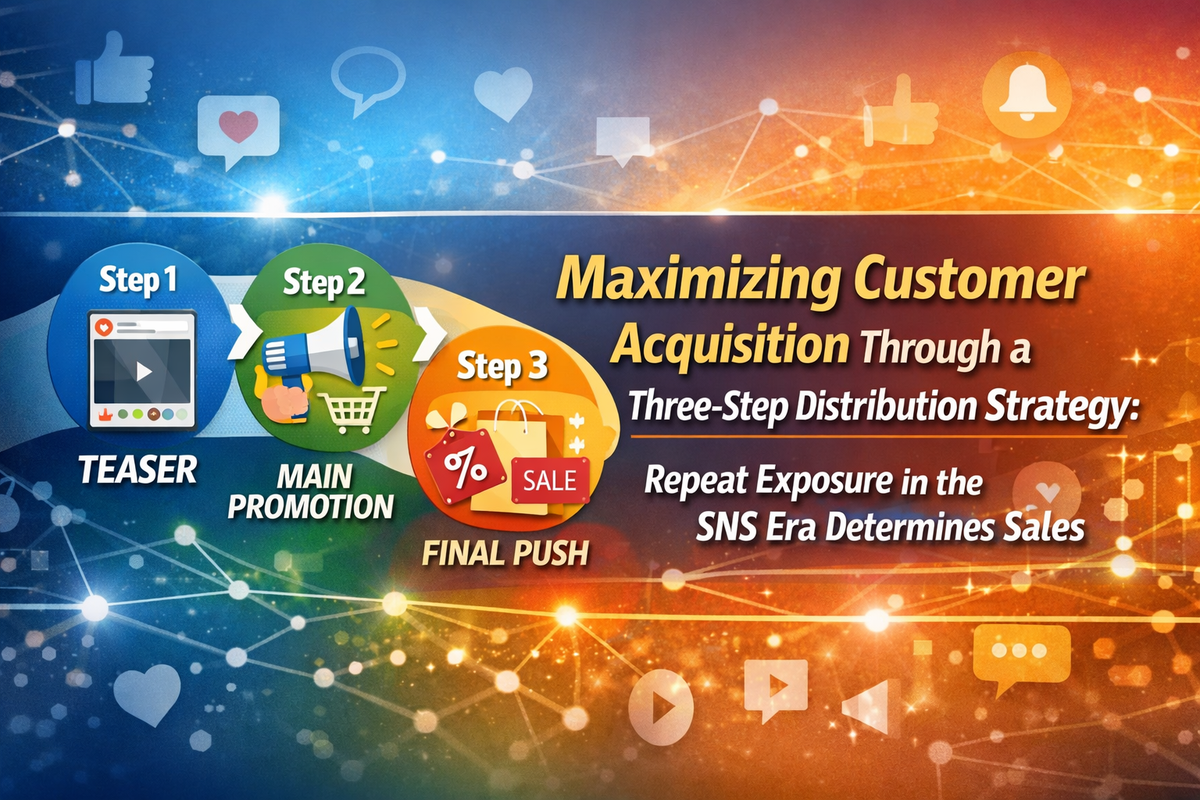
These constraints make it essential to adopt a promotion model that repeats messaging with different purposes at different times—the foundation of the three-stage strategy.
The Three Stages of Live Commerce Promotion
Stage 1: One Week Before — Awareness and Calendar Commitment
Objective: Ensure your audience knows the event exists and encourage them to reserve time for it.At this stage, aggressive selling is unnecessary. The priority is clarity.
Key Information to Communicate
Date and time (include the day of the week)
Theme or content overview
Target audience
Access path (profile link, landing page, etc.)
Example (Apparel Brand)“Live Streaming AnnouncementJoin us on Thursday, October 15 at 8:00 PM for our Fall New Collection Live Showcase.We will introduce this season’s latest styles and offer an exclusive 10% discount available only during the stream.Save the date, and check the link in our profile for details.”
Best Practices
Specify both the day and time
Clearly explain why the stream is worth watching
Introduce exclusivity lightly—the goal is scheduling, not conversion
Stage 2: Three Days Before to the Day Prior — Reminder and Intent Building
Objective: Trigger recall and encourage preparation behaviors such as enabling reminders, submitting questions, or planning attendance.
What to Emphasize
Countdown messaging (“3 days to go,” “Tomorrow”)
Tangible viewer benefits
Stronger exclusivity cues
Execution Channels
Instagram Stories and Reels
TikTok short-form videos
Multiple X posts with varied angles
Example (Instagram Stories)“🎉 Our Fall Collection Live starts tomorrow at 8 PM!Ask questions during the stream and receive personalized styling advice.Don’t forget to set your reminder 👆”
Key Principles
Use numbers to visualize urgency
Strengthen “live-only” value propositions
Avoid repeating identical copy—change the perspective each time
Stage 3: Event Day — Immediate Action Triggers
Objective: Capture last-minute viewers by eliminating friction and prompting instant participation.
Messaging Focus
Present-tense language: “Today,” “Starting soon,” “Now live”
Highly visible viewing links
Reassurance that late entry is welcome
Execution StrategyCommunicate continuously from several hours before the event through the live broadcast itself, ideally across multiple platforms.
Examples
1 Hour Before
Instagram Stories: “Starting in 1 hour! Set your reminder now.”
X: “Live at 8 PM today—still time to join 👇 (link)”
TikTok: “See the entire new collection tonight at 8. Live-only perks available.”
30 Minutes Before (LINE)“We go live in 30 minutes. Exclusive 10% discount available during the stream. Tap here to join ➡ (URL)”
After Going Live (X)“🔴 We are now live! Join here 👇 (URL)Feel free to jump in anytime.”
Critical Tips
Use action-oriented language such as “now” and “join”
Make links unmistakable and tappable
Lower psychological barriers with messages like “Midstream entry is welcome”
Defining Roles by Platform
Social Media: Expanding Awareness
Social platforms provide reach—but content is ephemeral. Success depends on creating repeated exposure through varied formats such as feed posts, stories, short videos, and text updates.
General Positioning
Instagram: Builds anticipation visually; reminder features enhance attendance
TikTok: Quickly communicates “why watch” through short-form video
X: Effective for countdown messaging and real-time updates
Typical Engagement Windows
7–9 AM: Commute checks
12–1 PM: Lunch breaks
4–6 PM: Post-work browsing
8–10 PM: Peak leisure hours
Optimal timing varies by audience, so platform analytics should guide refinement.
LINE and Email: Reliable Recall Channels
Unlike social feeds, direct messaging channels are harder to overlook and often perform strongly on the day of the event.
Operational Guidelines
Avoid excessive frequency to prevent opt-outs
One or two well-timed messages are typically sufficient
Recommended Timing
Evening before the event
Morning of the event
One hour prior (highest impact)
Example Message“Our Fall Collection Live begins today at 8 PM. Exclusive coupons will be distributed during the stream. Join here ➡ (URL)”
Owned Media: Reaching High-Intent Customers
Your website, app, and push notifications target users already close to purchase intent, while reducing reliance on third-party platforms.
Recommended Placements
Homepage hero banner
Push notification one hour before the event
Persistent navigation or account-page reminders
The shorter the path from viewing to purchase, the higher the conversion potential.
Three Common Mistakes — and How to Avoid Them
-
Announcing Too Early Without Follow-UpEarly promotion without reminders leads to forgotten events.→ Maintain a rhythm: one week → three days → event day.
-
Depending Solely on Social MediaFeed algorithms limit visibility.→ Combine social with direct channels such as LINE, email, or push notifications.
-
Repeating Identical MessagingUniform posts cause audience fatigue and declining engagement.→ Keep the core information consistent but vary the storytelling angle—benefits, behind-the-scenes previews, Q&A invitations, or teaser content.
A Practical Template: Change the Theme, Not the Facts
To increase frequency without increasing annoyance, package the same event differently at each stage:
One week out: Announcement — When, what, and who it’s for
Three days out: Value — Why it matters and what viewers gain
Event day: Action — Join now, here’s the link
Additional content formats can include:
Polls (“What is your biggest winter skincare concern?”)
Teasers revealing part of a product
Behind-the-scenes preparation
Explicit participation incentives
Conclusion: From Politeness to Strategic Precision
Marketing once prioritized crafting a single flawless announcement. In the live commerce era, success depends less on perfection and more on orchestration.
Deliver different messages, at the right times, across multiple channels.This strategic repetition is what ultimately separates high-performing streams from overlooked ones.
The three-stage promotion model is not merely a tactical checklist—it reflects how modern audiences allocate attention and form memory within fast-moving digital environments.
As live commerce continues to mature beyond 2026, competitive advantage will increasingly depend not only on content quality or product appeal, but on the precision of promotional design.
https://japan-solution.jp/ec-suppoterz/column/timing-for-live-commerce-announcements/
Tags:
Japanese EC
Japanese EC
この記事を書いた人
JASEC Japan Academic Society for E-Commerce